What’s in a badge?
The Arms of the Metropolitan Borough of Wandsworth were granted on 6th July 1901 by the College of Arms.
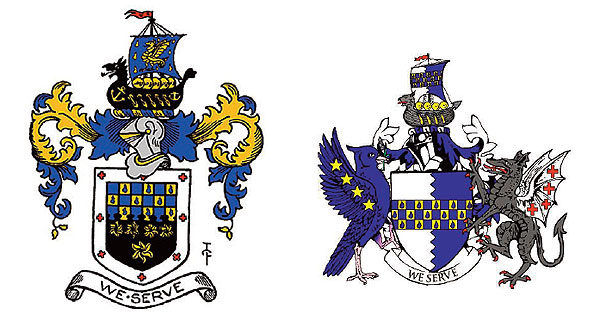
The blue wavy division represents the Rivers Wandle and Thames. French Huguenot refugees arrived in Wandsworth in 1685, and the blue drops represent the tears of their struggle. The five stars represent the constituent former parishes. At the top is a long boat, with a dragon’s head, commemorating 9th century Danish incursions along the river.
The chequers are from the arms of the Warennes, or Earls of Surrey. The crosses link the arms with the arms of the city of London. Following the merger with Battersea and the loss of Clapham and Streatham to Lambeth, new arms were granted in 1965.
The shield contains the main features of the arms of Battersea and Wandsworth. The white and blue indented field comes from Battersea’s arms, while the checks and teardrops come from those of Wandsworth. The blue and gold checks are from the arms of the de Warenne Earls of Surrey, denoting that the area was part of Surrey until 1889. As before the teardrops represent the Huguenot exiles.
The crest retains the dragon ship taken from the old Wandsworth arms. It has four oars and four shields for the four parishes of the Borough – Battersea, Putney, Tooting and Wandsworth. The sail is a banner of the arms.
The dexter supporter is taken from the crest of Battersea. The sprig of Lavender is for Lavender Hill, the main road of Battersea. The dove is charged on the wing with four gold stars, one for each parish. The sinister supporter is a black dragon, derived from the dragon-ship in the crest. The white wings and red crosses are taken from the supporters of the City of London. This shows that Wandsworth is a Greater London Borough. The crosses are four fold again for the four parishes.
Sources: A.C. Fox-Davies, The Book of Public Arms (T. C. & E. C. Jack, London, 1915) and Scott-Giles, C.W. : Civic heraldry of England.