Pavement to Classroom: Confessions of a Wandsworth School Teacher

Terry Mackie, 72 years young, has been an OW since 1978. Originally from Cardiff, he taught at Wandsworth School from 1978 -1986. He now lives in Welwyn, Hertfordshire, with his wife Irene, and they have six grandchildren. Chris Brown caught up with him to chat about his enduring relationship with the OWs, his love of rugby and his thoughts on its future at grass roots and professionally.
CB: Terry, you first played for the OWs in 1978. How did that come about?
TM: Chris, it was a total accident. I arrived at Wandsworth School as a supply teacher for French on Tuesday 7th February, 1978. I was living in Putney and needed a job. I had no training or experience in teaching! But I had a degree in Spanish and French. I kind of stepped off the pavement into the classroom. It was horrendous. I remember the date vividly because it was Shrove Tuesday and I told my first class that it was called Mardi Gras in French. They looked at me with complete contempt! I died three times in that 40 minutes and the lesson bell was CPR.
CB: So you had no idea of the school or even teaching? How did you get involved with the OWs then?
TM: No idea is an understatement! I remember a young but still terrifying Steve Lake coming into my classroom in the first week and doing a double-take, the conversation going something like this, “What are you doing here? You’re the bloke who ran the Threshers off-licence.” “That’s right. I know your lovely mum and dad from the dry cleaners. I’m your French teacher now, please sit down.” My first three months at Wandsworth were a permanent migraine. Two thousand kids, no formal training, I just hung on in there as I had a family to support, then one day a smallish, black-haired guy in a tracksuit heard me talking in the staff room and said I must be from Cardiff. It was Derek Williams and he was to be my guardian angel.
CB: Aha! Derek was the Head of PE and a rugby legend who inspired so many in our club to take up the oval ball!
TM: Derek really looked after me. He was the Good Shepherd of the lost sheep … Wales, where men are men and sheep are very scared … seriously, Derek was a godsend. And in his department was another excellent Welsh guy, Mike Griffith. They both played for London Welsh, which in those amateur days was the greatest rugby club in the Northern Hemisphere, having contributed six British Lions to one tour in the early seventies.
CB: So, how was your rugby?
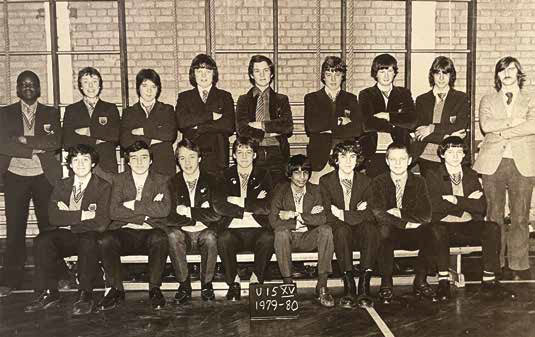
TM: Non-existent right then! I had played at school since the age of eight, but I was really a footballer – decent left foot, got around the park. But, coming from Cardiff, I knew rugby inside out. Derek recruited me into the annual staff v boys match in May 1978 and that was my first intro to Claygate. I played full back and didn’t have much to do as we had an excellent side with the likes of Paul Snare. One day a kid knocked on the staff room door at lunchtime and said to me he had to speak to the one we call James Bond. I replied, “You mean James Hunt?” “that’s the one”, he replied. The team also included Colin Tucker (Design Tech) who also played for London Welsh, Malcolm Jones and Graham Allan (both Science) who played for Merton, plus some really fit PE guys. Derek suggested I had a run out for the OWs in the new season and I played my first match in the September for the fourths. The great John Totham was captain and another legend Gerry Johnson was in the pack. I remember it was a very sunny Saturday and we won by about 60 points to nil. The oppo was lucky to get nil. I thought this seems fun and I can get fit.
CB: So you really got back into rugby from then on?
TM: Definitely, it was a kind of lifesaver for me at that time, both professionally and socially. Derek soon had me looking after one of the lower school rugby teams for matches and he then asked me if I would consider doing games instead of French on Wednesday afternoons. No brainer! I was being invited to swap teaching a whole three hours of trying to educate mostly unwilling and bored teenagers in a love of French verbs for a run-out on the playing fields! In time my coaching improved (I went on some courses through Derek) and after Mike Griffiths left teaching I inherited the 1st XV. Dear Mike (who died tragically young at the age of 60) had schooled this team brilliantly. There was the nucleus in it of those guys who went on to win the Surrey Colts’ Cup, a major achievement given the strength of rugby in the county. I treasure having been involved in the rugby careers of really good players like Andy Carter, Andy Archer, Martin Smith and many others.
CB: We heard a lot about your voluntary involvement with school sport, but how was your main role as a Wandsworth teacher?
TM: I started as a casual supply and ended up Head of Languages when the school closed in 1986. Mostly because the other staff kept leaving! I had early on gained an MA from Birkbeck College, University of London, part-time, and that gave me confidence. I started teaching Spanish in Wandsworth and in its successor school, the ill-fated John Archer School. I eventually made a new career in education administration in both England and Wales. I ended up as Acting Chief Education Officer of Newport. When I retired I founded a consultancy with a friend and we did some good stuff on education in the UK and abroad, including a large contract in Pakistan (great money but beyond scary). I started writing about education in my later years, mostly for the Welsh press.
CB: You played about 13 years for the OWs?
TM: That’s right. I was mostly second team, full back, wing or centre. Later I did some coaching for the club. I was club secretary for three years and I organised two crazy tours to Cardiff for the Wales v England game. I was captain for one year of the seconds, we had a fine team, Graham Sparks at no 9, what a pass he had. Micky Curtis was playing ten and Peter Cook was in the centre. I played on the wing that year and scored 20 tries. I just dotted them down. I did a bit of goal-kicking as well, from the right as I was left-footed, and Jack Saunders came up to me late in one game when we got a potentially match-winning penalty and whispered in my ear that if I kicked the goal I’d be let off my subs that week. I scraped it over the bar through the posts and soon the final whistle went. As I was trotting back to the changing rooms feeling very pleased with myself I realised Jack the Butcher had carved me up: I had done the shirts that week and so was already exempt from match fees. That was Jack all over!
CB: Your best rugby memory with OWs?
TM: I was just 35 and probably as fit as I would ever be. Slippery Maclean soon had me in the Vets team and at our annual tournament we played Rosslyn Park in the final. The iconic Andy Ripley had turned out for them. This guy was an absolute hero; England No 8, British Lion and actually a kind of rugby rock star, super-fit in his day and charging round London on a motorbike. I was playing fly half. We won a lineout on the halfway and I stepped their geriatric flyhalf. Andy came across to cover and I stepped him, too. I scored under the posts and as I was running back the Superstar tousled my hair and said, “nice one, son.” I can’t remember if we won or lost that final, but Ripley’s words are my finest sporting moment of a very undistinguished career of football, rugby, cricket and tennis.
CB: You have some strong views on the future of rugby, I gather?
TM: Not many kids watch much rugby these days, even on the TV. There are so many other choices for them. Parents are voting with their feet away from rugby as the game is plagued with injury and concussion. Clubs are closing every week in the UK or going down to skeleton sides. I coached some mini-rugby at Hemel Hempstead a few years ago and was one of the few coaches who actually had playing experience. Professionally, the players are dangerously huge and the collisions come at a massive cost. It’s simple physics: mass + speed = force = huge risk. The balance of rugby has gone away from a game of quick passing and skilful evasion. The World Cup final summed it up: more cards than a poker game, more subs than you can see in a Das Boot box set and scrum penalties deciding the closest matches, with tries as rare as hens’ teeth.
CB: Terry, sum up what the OWs means to you?
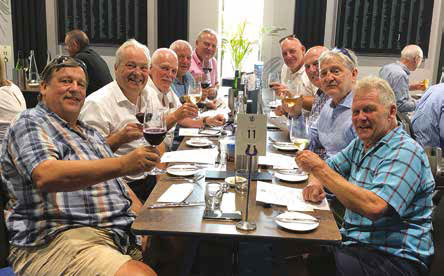
TM: Chris, I have been in many clubs, especially for cricket (which I played averagely for 30 years, mostly with Bertie, who had just one shot, heave to leg, annoyingly it often went for four) and tennis (fifteen years and counting now, standard below average) but nothing touches me like the Dubs. After 45 years they still can’t shake me off! I think being a part of the OWs is a bit like having done military service, being in the army or navy (not the RAF as none of us would have passed the exams). We were a band of brothers and we always will be. Meeting up at the Dave Pollard Lunch or going to the Oval with a group of guys through Alan and Colin, these are very special times. None of us are getting any younger!