A Ceremony of Thanksgiving for the Life of H. Raymond King
16th July 1983
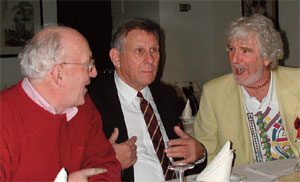
Mr Nelson F. Roberts spoke about his memories of Woking
“I am a fraud (some of you knew that a long time ago) as I was asked to talk about Wandsworth during the war, yet I only came to Wandsworth in 1944. So my experience was a bit limited to say the least of it. However, I’ll do my best. I want you to take yourself back into what must seem, to these young gentlemen (audience), history. The date, sometime in September 1944, it was a Friday and the place is a little village in South Wales. Suddenly a knock at the door, there stood a strange lady. “I’ve come to take Nelson back to his new school; he should have been there a fortnight ago.” Oh dear! The papers had got lost in the post. And so Nelson was packed up just like that.There wasn’t much to pack up in those days and passing through Wimbledon without a sight of his dear Mum, he was immediately whisked off to Woking.
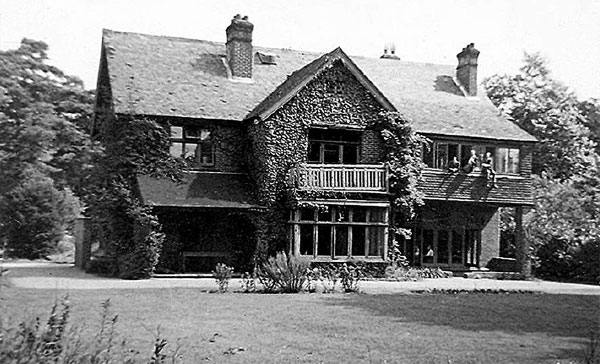
Now I was a very thin boy in those days and not very tall either and you can imagine that by that time I was very tired and very scared and very bewildered and when I met the people who were looking after me in our hostel Little Firs I was even more bewildered, because one was Mr Phillimore, whom some of you may remember, a man of gargantuan size and appetites. The other was Mr Prior who was exactly the opposite of Mr Phillimore and of course the third member of this triumvirate was Matron; we’ll say no more about Matron; some of you remember. Now the weekend didn’t go very well. The boys tried to be kind. Philly did his best I suppose in his blustering way, but when Monday morning came I was completely panicked and the walk from Firlings to Little Firs I can still remember. It passed Mr Bramley’s orchard and there were still apples on the trees and the boys had told me over the weekend what happened if you got caught taking Mr Bramley’s apples.
Anyway I got to the school; it was a lovely building, very charming, behind the blast-proof walls in front of the doors. I finally went up to see the headmaster, and I can honestly say that it was then that my panic and fear and so on left me. The boy who had gone to school like the very slowest snail that Shakespeare ever wrote about, suddenly cheered up because there was this very distinguished, dignified gentlemen with a rather severe face suddenly being very kind to a little eleven-year old boy and after he had welcomed me the next thing he did was, I think very typical of HRK. He said “Does your Mother know where you are” “No, sir.” So straightaway on the telephone to the public house opposite to where we lived he let my mother know where I was. Now that was typical of HRK. Underneath the dignity, underneath the great scholarship, underneath the great strength as an educator lay a tremendous fund of sympathy, a tremendous humanity and dare I say it, a great humility.
Now I don’t want to go on a lot about Woking because people who weren’t at Woking wouldn’t believe it. I can see Maurice Ascher over there. He knows all about the illicit cooking, parties, he knows all about stealing ammunition from the local dump, he knows all about Philly doing more gardening than mathematics; he knows all about… I could go on and on, but I won’t because it is just boring unless you were there. But it was great fun. What I really remember was the tremendous versatility of the whole staff. HRK was a great leader; he had with him Dr Wardale. Dr Wardale was a great musician, a bit afraid of boys, I think, but a very distinguished musician; and he taught us English. There was also Mr Cowan, Sammy Cowan, one of the loveliest men you ever met in your life. The real schoolmaster, a smashing chap; you boys would have liked Mr Cowan, I know that. And he taught us art, although he was an English teacher, of course. And then of course there was Mr Hatfield. He started to teach us French but then I am afraid he taken very seriously ill. He was the Hatfield of Ascher and Hatfield, Cours Illustre (correction from Maurice Ascher: Cours moderne). When he was taken ill the head boy took over and it was like that. Alan Rimmel, he did a jolly good job too. I came top. Of course the most memorable of all was the headmaster. He took us for speech and I can still recite “The crowd around the county ground loudly shouted “Out”. And so on, I won’t bore you with the rest; you probably know it anyway. Our first form room was, I suppose one of the back bedrooms and it was right next to the head’s study. Why he never came in and slew us all I will never know, but he didn’t and he certainly wasn’t deaf.
I strongly suspect that he was exercising his very well developed sense of humour and I wouldn’t be at all surprised if he had a hole bored through so that he could listen to what we were saying even more clearly. However, as boys we weren’t honestly aware of all the great difficulties of the school with the war. We knew that the school had been uprooted, sent down to Woking, to a large private house with some boy’s living in hostels; I was living in Little Firs with Mr Phillimore and Mr Prior. Others were living at Perbt Court with Mr Makin and his wife; they had very spartan conditions there too, Mr Makin spent a long time telling me just how spartan their conditions were. Others were boarded out with private families. Very few staff of course but what staff they were! Apart from those I have mentioned, Mr Fenn, Charles Terry, now there’s a man! A great scholar a little bird of a man, always with a stiff winged collar and yet the story was, but I have reason to disbelieve it, that this man had been a secret service agent in the First World War. It’s unbelievable, especially when you saw him on his bicycle. You remember that, Mrs. King (in audience), don’t you? Then I’m quite sure that the time when I joined the school difficulties were even greater because by then the drift back had begun, leading to their opening of the old building then shared with the London Fire Brigade. HRK was now running two schools. Mr Ascher was up here by then (Wandsworth), helping to run this place and HRK was down in Woking. It must have been extremely difficult and yet to the boys, we were completely sheltered from these worries. Certainly I was, as a first year. To me, it was a time of great freedom, of great enjoyment, I almost said great licence, but I held myself back.
We really enjoyed it, but the thing that I learned most, I learned at Woking, the most important thing was something to do with our motto. Now the boys (audience) know our motto is “We Serve”. We served at the hostel, we did the chores. We did mounds of potatoes. The staff served in all sorts of ways and nobody served more deeply, nobody served more unsparingly than HRK. Take one tiny example: this man with his splendid first war record, served as a comparatively junior NCO in the Home Guard in the Second World War. So when you look at your badge and see your motto, do remember that there are people who do believe in it, there are people who have lived that motto and I hope you will continue to try to live it just as I have. But then I had the advantage of having the greatest mentor of the lot, a man whom we are met here to honour, H. Raymond King.”