More Sevens Reflections
Mike Burriss
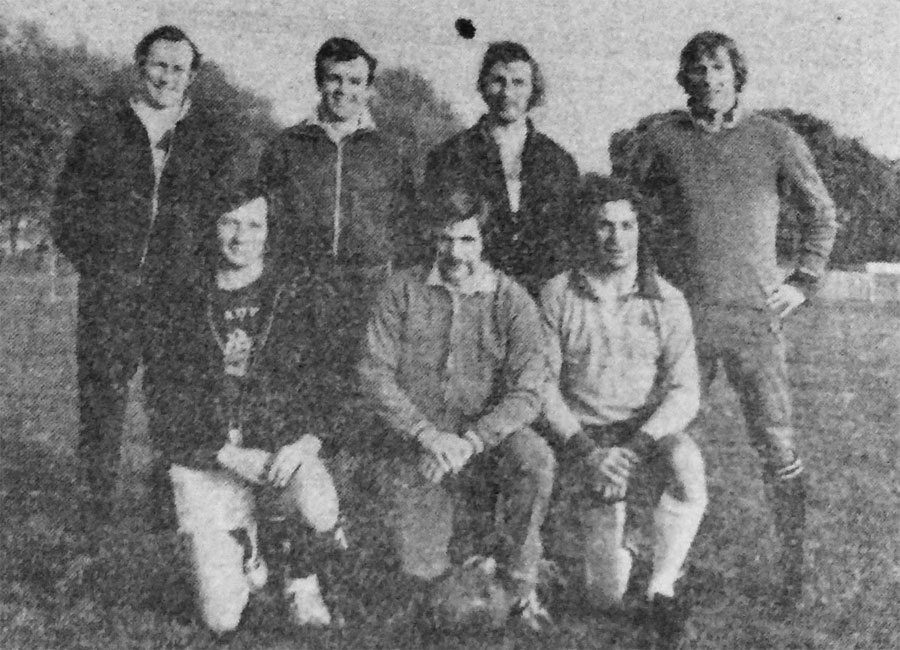
Front Row: Pete Dutch, Jack Saunders, Tony Berry
Another aspect for the success of the Old Wandsworthian’s 7’s team performances over the years was the consequence of players being encouraged to join training sessions to develop their skills, and from this, good squads emerged.
It was important that experience of tournaments should be achieved, so teams where entered at different venues which benefited all. For example in the mid-sixties, a team was selected to participate in the annual Oxford sevens, which attracted a number of major clubs, and in 1966 OW’s reached the final rounds. From this and other tournaments the club identified the strongest squad which culminated in our success at the Middlesex and Surrey sevens in 1969, together with regaining the Totham Trophy at our own tournament in September of that same year.
The following year 1970, we reached the semi final, which meant we had qualified, for the final rounds of the national Old Boys 7’s tournament held at Richmond, the following week.
OW’s together with Old Haberdashers had developed in response to the RFU’s centenary celebrations. We were again semi-finalists of our own tournament in 1971 and went to Moseley Birmingham for the finals (they returned to Richmond the following year).
At the beginning of the 1971/72 season, little did we know what an excellent year it would become, winning 26 games and scoring over 600 points, and losing only 4 games.
This success gave us a lot of confidence entering the 7’s season. Unfortunately, I have no details of earlier tournaments until the Middlesex preliminaries on 22 April 1972.
Our first game was against Old Haileyburians 2’s who we beat 36–0 which reflected a dominant display of ball skills, support play and confidence in abilities.
Our next opponents were Old Dowegians and again we played with confidence with assured handling and support play winning 28–6. This meant we would be facing Richmond 1st in the third round.
We prepared as we had done in the previous rounds, endeavouring to relax and encourage each other that we had a chance. Also, knowing Richmond’s expertise, standard of play and quality of players which included internationals.
We received a tremendous reception from our supporters and the rest of the large crowd all around the pitch. The first half was cat and mouse, with each side probing for gaps to exploit. The half ended with Richmond leading 6–4, with Ian Stephenson scoring our try in the corner. In the second half, OW’s stepped up their game and reclaimed the lead through Ian Stephenson again. This was followed by strong running tries from Jack Saunders and Mike Burriss to give us a lead of 18–6. Richmond rallied but could only managed one more try in the last seconds before the final whistle.
The score at the end of the game was 18–12 and the OW’s were going through to the final preliminary round, having given an excellent performance.
Our opponents were Old Paulines, for whom this was a home game and OW’s gave another very assured performance with their confidence sky high after beating Richmond. This lead to a comfortable 14–0 victory. The realisation pinnacle of 7’s rugby…the Middlesex 7’s finals at Twickenham on 6th May 1972.
The final rounds were two weeks away and the team wanted to maintain momentum, so we were able to gain entry to the South Coast 7’s at Havant RFC. We travelled down in a coach full of supporters, together with those who made their own way, all arriving in plenty of time to prepare. It proved to be very helpful to have a number of games, but we eventually lost in the semi-final by a couple of points.
Middlesex 7’s Finals
Although we were the first game on and Twickenham was not full, we still received a very warm welcome from the crowd with our supporters very much to the fore.
Harlequins, as we know, are one of the biggest first class clubs in the country with a number of internationals and their selection reflected this on the day. However, we were not deterred and had confidence in our own abilities, but it was not to be, losing 24–10, with Dave and Paul Snare, scoring in each half.
Though disappointed with the outcome of the match, we came away with heads held high as to what we had achieved. The experience we gained was memorable and the support we received from club members, parents, family’s and friends was very much appreciated.