Joshua Bell – 2015
Royal Grammar School Guildford – Teaching in Cambodia
It’s 6:11am on a 34°C Sunday morning in Cambodia, twelve 16 and 17 year old teenagers slowly climb out of their hammocks. Groggy eyed and feeling the effects of the six days of teaching that have already past, they make their way out of the classrooms turned sleeping quarters. Despite the fact that school starts at 7:30am there are already a large group of children waiting to be taught. I was amongst that group of twelve that travelled across the globe to Cambodia with the Royal Grammar School Guildford. I am currently 16 years old and starting 6th Form/A-Levels in September this year. I am very thankful for the support I received from the Old Wandsworthians Memorial Trust which, together with two years of fund raising efforts, enabled me to go on this life changing experience.
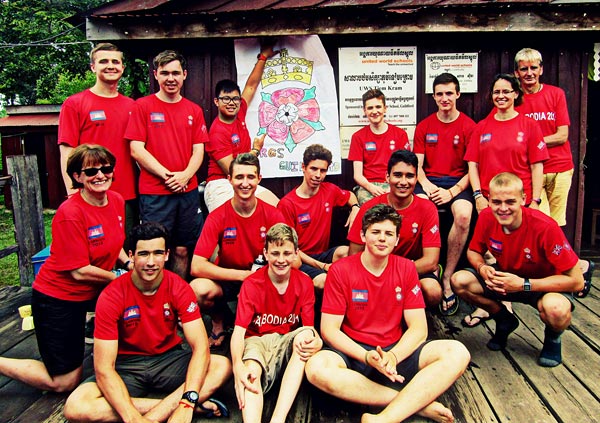
Cambodia is a relatively small country in Southeast Asia which only forty years ago was under the rule of one of the most brutal regimes of the 20th century. In the space of four years Pol Pot and his associates killed roughly two million people, a quarter of the entire population. Anyone educated, defined by their profession or simply whether they wore glasses, was killed and everyone else was sent to work impossible hours in the countryside. It is because of this that Cambodia lacks the fundamental backbone that a country needs; education.
The expedition started in Phnom Penh with three days acclimatisation. In this time, we visited the Killing Fields and S21 Prison. Witnessing the cruelty that took place here was one thing, however, hearing the sole survivor of S21 talk about his ordeal was truly eye-opening. His key message of forgiveness above revenge is something which is reflected across the whole country. After a trip to the Angkor Wat temples, we travelled to Ratanakiri, a remote province in the North East of the country. From here we travelled to our first school.
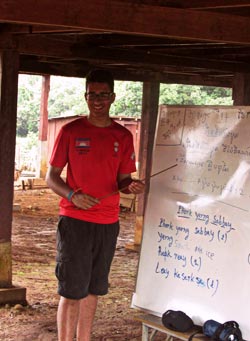
Tien Kram was set up in 2010 by United World Schools with sponsorship from my school, The Royal grammar, Guildford. It has grown to a complex of three classrooms and has had a staggering effect on the village itself; the child mortality rate has been reduced by 50% and child trafficking has almost entirely stopped. However, the education still has several shortcomings. Many of the teachers lack training and the curriculum has no creative subjects. Thus, the subjects we would be teaching were Art, Music, Individual Logic and Group Logic. The double language barrier meant that we would have to come up with new and innovative ways of teaching.
The subject I taught was music. Since the children had experienced nothing like it before, we had the aim of teaching them several simple songs in English. Despite it being their summer break, the children turned up in large numbers. The 6 – 11 year old’s ranged dramatically in ability, however, they picked up the songs very quickly. The lessons were not the only part of our teaching. Half an hour of sport, four lessons, story time, individual skills and a play made up the timetable. The individual skills varied greatly from bracelet making to makeshift ten-pin bowling. We wrote and performed two different plays and, at the end of each one, the children got to put on the costumes and perform it again with them in the roles!
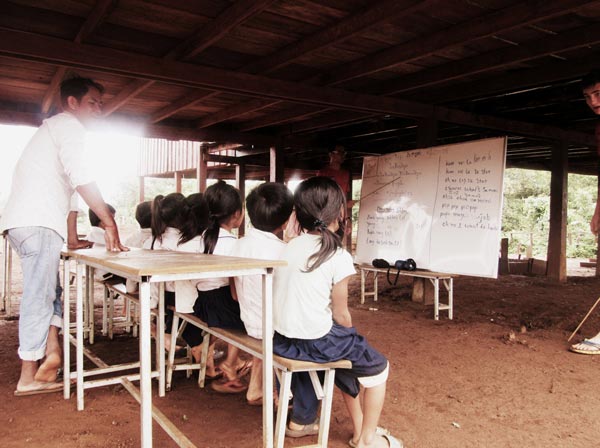
When school finished, the children would stay for several hours afterwards, playing games and more. Their desire to learn was simply staggering and made all of us realise how fortunate we are. We left Tien Kram in high spirits and headed towards our next school, Kmaeng.
Set up only months before our visit, we were among the first Westerners to travel to Kmaeng School. It stand on stilts above the ground with the layout being similar to Tien Kram. However, the children were strikingly different. They were just as keen to learn but in a different way. When we first arrived, none of them even knew what a high-five was and most were very reserved. Our biggest challenge was trying to get them to open up, especially in music where they had to sing out loud; by the end of day one we could already notice a huge difference.
The morning after is where my report began, 6:11am on the Sunday morning. For us, the fact that the children were so keen to get into school was hugely encouraging. The highlight of my trip came on this day when every group managed to sing through all the songs. The smiles and cheers that came with it will be something I remember for a long time. We could also see how our teaching had benefitted in other ways. Near the end of our time teaching, the translators wanted to try teaching the children a Khmer song and, using the methods they had watched us use, did so successfully. As we waved goodbye shortly after, some of the children were crying as they were so sad to see us go.
The remainder of the trip was as jammed packed as the rest. A four day trek in the jungle was followed by time in Sihanoukville and Phnom Penh. We returned to UK full of stories and as new people. While we had been teaching the children, we had been learning ourselves. The skills, lessons and attitudes I found in Cambodia will be taken into my future life. For that, I am incredibly grateful for the grant I received from the Trust.